
A community engagement initiative of Centralia HSD 200.
Spring | 2026
The People Who Run the Halls
“Both say the same thing when asked why they are office workers: they wanted to know the teachers.”
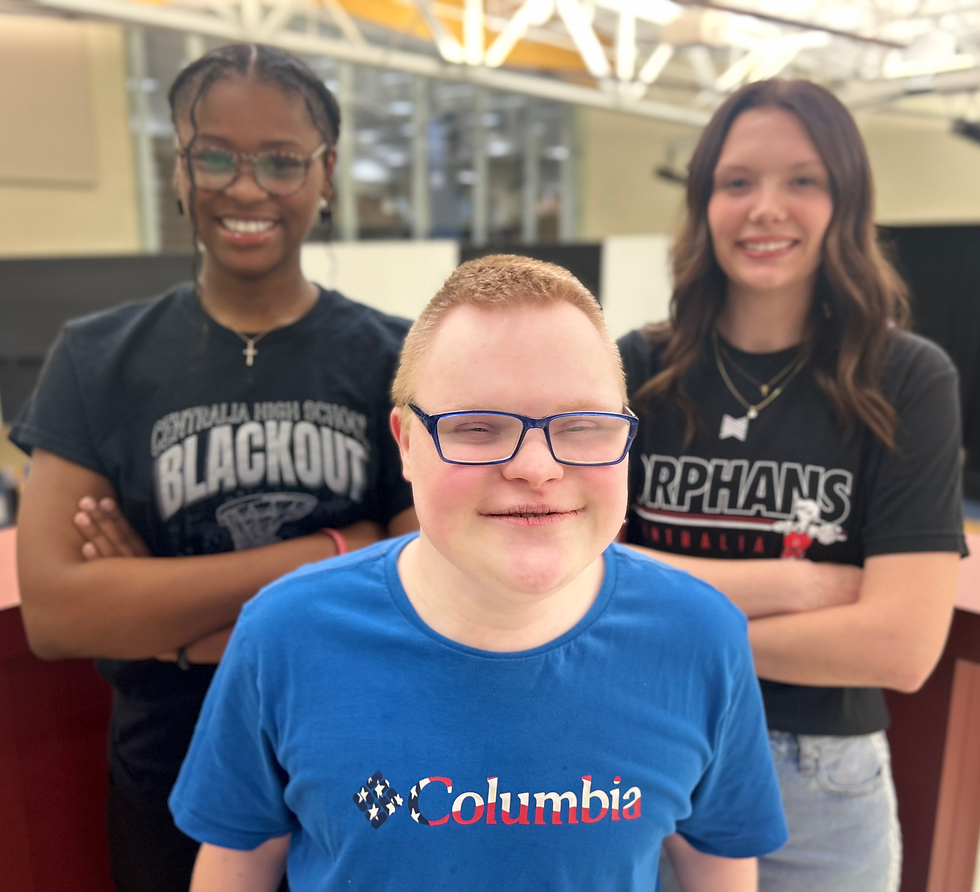
Every morning at Centralia High School, before most students have settled into first period, a small crew is already moving. They walk the hallways with passes — green ones from the attendance office, purple ones from guidance — delivering news to classrooms, collecting old passes left outside doors, and keeping the daily flow of information moving from the offices to the teachers to the students. They are student office workers, and most people at the school see them without fully registering what they're doing or why.
Jamayah Wallace works first hour, assigned to the attendance office under Mrs. Kuder. She's quick to acknowledge that first hour is the busiest. When students have missed a day or accumulated absences. Jamayah carries it to the room, hands it to the teacher, and the student follows it down to the office. From there, Mrs. Kuder logs the arrival time, writes a behavior slip, and sends it along to Mrs. Starr, who handles the follow-up. "I bring passes," Jamayah says, "and if the pass says ‘now,’ they come down." The teachers know what a first-hour visit from the office means. So do the students.
Mackenna Michael and Jacob Draper work second hour, based out of the guidance office. Their passes are purple — early dismissals, mostly, for appointments: doctor visits, dentist, whatever a family has scheduled that day. Jacob collects the pass stack from the guidance office each morning, organized by hour on the wall. Ms. Snyder has them ready. Then the two of them run the loop — delivering to classrooms, picking up expired passes that teachers leave outside their doors, rotating through the building until the hour is done. "We're always running," Mackenna says. Jacob nods. It's a full period of work.
Jacob is a student with Down Syndrome who partners with Mackenna every day. He organizes the passes, delivers them to teachers, and helps collect the ones that need to come back in. Mackenna describes the partnership simply: "He's always keeping a smile on his face, and that keeps me going." Working alongside him has also been preparation for her future. She's heading to SIUE in the fall to study speech pathology, and she says the daily experience of communicating with Jacob — learning patience, learning to listen carefully, learning to brush off the small frictions of working in a building full of people — has sharpened skills she'll need. "Some people do, some people don't understand," she says. "I feel like it's helping me learn and be patient."
The student office worker program runs every hour of the school day, typically with two students per hour and three during fifth. It's open to juniors and seniors, and for most of them it counts as a class period — not a break from school, but a class in itself. Neither Jamayah nor Makenna gets paid. Both of them chose to do it anyway, and both say the same thing when asked why: they wanted to know the teachers. "I haven't met every teacher," Jamayah says. "I haven't had all of them yet. I find it super intriguing to see how all the different rooms are set up." Mackenna puts it similarly: "Going in there every day, they have to see your face. You get on a deeper level with them and connect."
Outside of office work, Jamayah plays basketball and holds offers from Kaskaskia College and Lewis and Clark Community College. She plans to study criminal justice with the goal of becoming an attorney. She's also in FCA, the ARC club, and the Spirit Club. Mackenna plays soccer and is in FCA, Spirit Club, and History Club — the last of which she recommends primarily for the field trips, though she insists the history is good too.
The passes keep moving. The building keeps running. Most students never think twice about who's carrying them.