.png)
Add a Title
Designed to Solve, Built to Last
"God gives you challenges, and you have to rise up to those challenges, and you will succeed."
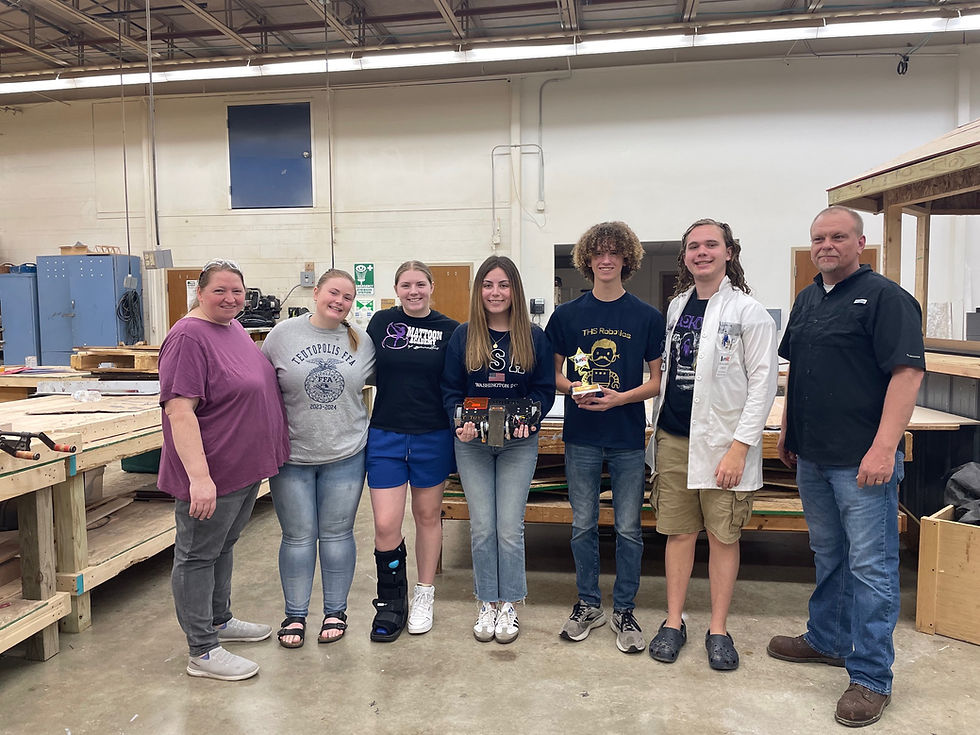
The space Jill Spour stewards at Teutopolis High School doesn't look like most classrooms. CNC machines. Mills. Laser engravers. Form machines. 3D printers. AC/DC trainers and PLCs — the actual equipment of the manufacturing world, not simulations of it. Students from Teutopolis and surrounding schools come through this program and encounter possibilities they didn't know existed an hour before.
That's exactly the point. And getting here was anything but a straight line.
Spour is a Teutopolis graduate herself — class of 2001. The spark came from a teacher named Dennis Custer, who taught AutoCAD and was, by her account, a phenomenal educator. She fell in love with the work. By senior year, she knew she wanted to design houses — she had her dad's mason's eye for how structures come together — and went home to tell her mother she wanted to be an architect.
Her mother had a practical question: how many architects are in Effingham County?
The answer sent her to Lakeland College for civil engineering, then to a 15-month internship with IDOT in the CAD department ("I absolutely loved it"), then to Eastern Illinois University for her bachelor's in applied engineering, and along the way to an internship with General Electric that opened her eyes to how complex — and fascinating — manufacturing could be.
Still, something quiet kept pulling.
"I really liked that CAD at school," she says.
When a counselor at Eastern told her that industrial arts certification required her degree plus 2,000 work hours — and she already had both — the path to teaching suddenly cleared. She applied for a position at Stewardson-Strasburg, got hired, and delivered her daughter on the literal first day of school.
She went back at nine weeks. And then fell in love all over again — this time with teaching.
Four years in, budget pressures threatened her position. She was a single mother. Her daughter was dealing with some health challenges. When GE called and asked her to come back, she made the hard call.
"I have to have a job," she says simply.
What followed was more than job stability. Working in manufacturing gave her something most educators never gain: real-world depth. She saw how systems actually function, how they fail, how people solve problems under pressure. When Teutopolis eventually came calling, she brought all of it back to the classroom.
But first there was the health chapter — a craniotomy, followed by complications that left her in a wheelchair for two and a half years. A spinal fluid leak from her ear. A drain placed in her lower back that caused another leak. COVID arriving at exactly the wrong moment, pushing back treatments she needed. Eventually, she had to travel all the way to California for a blood patch procedure that finally fixed it.
She taught through all of it, from the wheelchair, without stepping back.
"My passion is to share it with these kids," she says.
That passion now runs through the Make It Manufacturing program she facilitates through a partnership with EFE340 — open to students from any surrounding school, not just Teutopolis. She tailors field trips to manufacturing facilities in the students' own communities, wherever they're from, so the connection between classroom and career feels immediate and local.
And then there's robotics.
When Spour arrived at Teutopolis, the Internet Society Robotics Club had just lost its founder — Al Church, a retired English teacher who had started the whole thing. She took it over. Her students built their first competition bot and named it Magic Al, in his honor.
Their business partner, Jake Dateman of Prairie Land Design, helped fill in the manufacturing knowledge gaps in those early years. And the team needed it. The first competition trip — Kansas City — was humbling. A bad outlet in the building meant the bot never charged properly. It sat motionless. They drove hundreds of miles to watch nothing happen.
They came back the next year with a vertical weapon that demolished their first opponent. Then the belt's teeth sheared clean off from the speed. With 20 minutes between matches, the students — and only the students, because Spour can advise but not touch — zip-tied it back together, improvised, adapted, and kept fighting through a double-elimination bracket. They pulled a third-place finish out of it, competing against programs with full trailer setups and multiple spare bots.
This year, they've redesigned with a horizontal weapon and a new drive system. They're ready.
"You have to be creative," Spour says. "You have to think outside the box."
When asked what she would choose if she were a high school student today walking through a space like the one she runs, her answer is specific. Biomedical engineering. Prosthetics. She once had a student at Stewardson-Strasburg who was in a bad accident on his way to school and lost his leg. That stayed with her. She'd want to be the person designing what comes next for kids like him.
Her daughter, meanwhile, is making her own path — and it looks like something Jill might have drawn up herself. A Teutopolis class of 2025 graduate, she spent years telling her mom she'd never take one of her classes because they seemed too hard. Jill convinced her senior year. The verdict: "Oh my gosh, Mom, I loved your class."
Now she's at Eastern Illinois University studying pre-physical therapy, competing in Excel Diamond gymnastics — heading to Alabama in April — and has had two pieces of artwork travel all the way to the Cannon Tunnel in Washington, D.C., having won the congressional art competition twice. She wants to own her own gymnastics facility someday, with a physical therapy center built inside it.
"Don't let anybody tell you that's not what you want to do," Jill tells her. "It's your dream. You make it work."
She learned that the hard way. And she teaches it every day.