.png)
A community engagement initiative of Martinsville Schools.
Spring | 2026
Learning to Lead: High Schoolers Find Their Footing in Elementary Classrooms
"Helping them out makes me happy."
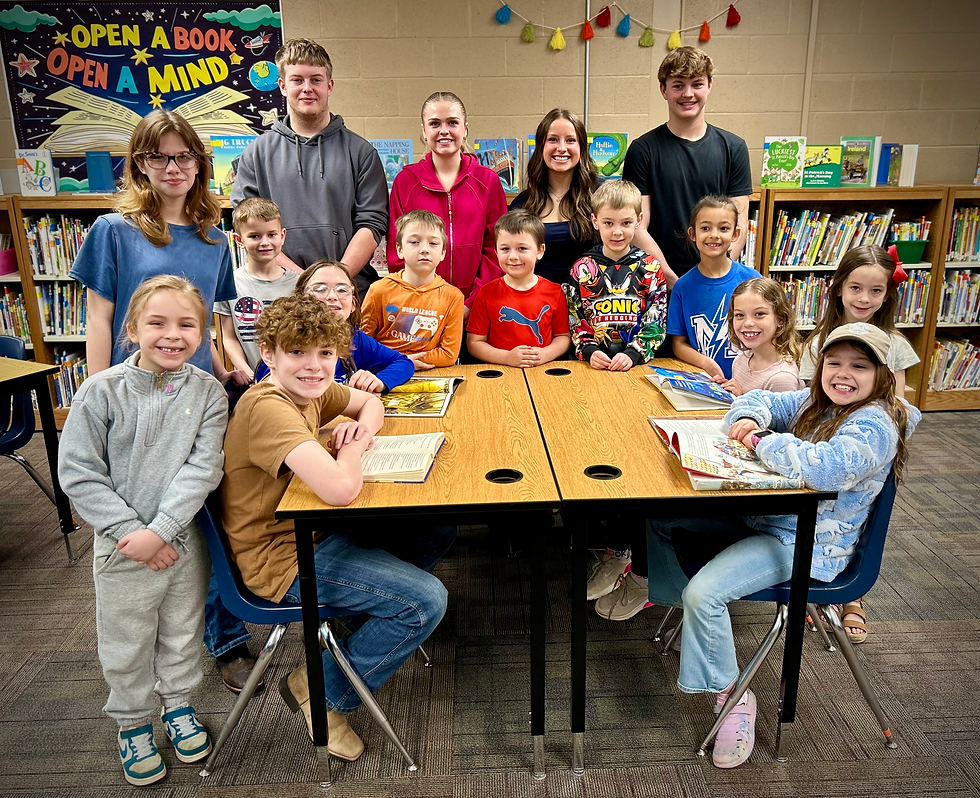
Every Tuesday and Thursday morning, a small group of Martinsville High School juniors trades their usual seats for something far more unpredictable — a room full of elementary school kids eager to learn, eager to talk, and very much eager to jump on anyone willing to help them.
That's life in Foundations of Teaching, a class offered at Martinsville High School by family and consumer science teacher Lora Parcel. The class gives students a window into education — not just as a career path, but as a life skill — through classroom experience at Martinsville Elementary School twice a week.
"It's set up to give opportunities to see if kids who want to be teachers, or maybe want to be teachers, or don't know if they want to be teachers yet," Parcel says with a smile. "That's what I say — when they really think they don't want to be a teacher, you just don't know yet that you want to."
The class meets first hour at the high school, from 8 to 8:50 a.m. On the days students head to the elementary, some stay through a second period, giving them more than an hour and a half of hands-on experience. This year's group is small — just four juniors — but what they're gaining is anything but small.
Harper Baird already has a soft spot for the little ones. As a cheerleader, she helps run Spirit Sparkler, a cheer camp for elementary kids held twice a year. Working in the classrooms feels like a natural extension of that. "I love working with them and being around them," she says. "Helping them out makes me happy."
Trinity Simons is helping in a second-grade class and both kindergartens, carrying a well-loved copy of Pete the Cat to her sessions with a first grader. Kaden Wilhoit spends his time in fifth grade assisting with social studies. And Gabe Griffin works with both third-grade classes, helping students with English and math — squeezing in his time before heading off to building trades, where his class is working on a project at the ballpark.
Griffin admits that when he arrived each morning, something unexpected happened. "I love working with the kids. It's fun, it's exciting — the kids love me for some reason," he says, laughing. "I always get in class, and they all jump on me." But then the real work begins. "They stay focused whenever I work with them, and it's good to see the progress once we get through books and math facts. Every single time they finish a book, they always pass the test."
Wilhoit didn't come in with plans to be a teacher — and still doesn't — but he found unexpected value in the experience. "It's good to come over here to understand how people learn differently," he says. "It's a good way to learn how kids are motivated and how they understand things better. That's great for future life — if you want to start a family or whatever."
Parcel reinforces that broader purpose often. The lessons learned here — about differentiated instruction, developmentally appropriate practice, and recognizing how different brains work — apply well beyond any classroom. "Even if you want to teach Sunday school, help with a youth group, coach your child's T-ball team," she says, "this is going to help you."
On the days students aren't at the elementary, Parcel uses class time to debrief, reflect on what's working, and dig into the terminology that underpins good teaching. The fourth quarter will bring another layer: students will begin developing and teaching their own lessons in the elementary classrooms, with input from cooperating teachers.
The program also carries a quiet hope embedded in its design. The high school and elementary have worked together for the better part of a decade to bring student helpers into the lower grades, and Parcel sees it as more than a class assignment. "We'd really like for kids from their hometown to go and get an education degree and come back and pour into our community even more," she says.
She's living proof it can happen. Parcel grew up in Martinsville, graduated from Eastern Illinois University, earned her teaching certificate from Indiana State, and recently completed a master's degree in early childhood education — all with an eye toward making Foundations of Teaching a dual-credit course through Lakeland College, a goal she's actively working toward.
Ask the students to sum up the experience in a few words, and the same themes keep coming up: fun, inspiring, eye-opening, challenging. And above all — patience. "It's definitely challenging," says Simons, "and definitely patience." Adds Wilhoit, "It's eye-opening. It's a lot of learning and patience."