
A community engagement initiative of Seneca TWP HSD 160.
Spring | 2026
Life Skills, Real Jobs, Real Confidence
They're getting a lot more job skills and opportunities to practice them."
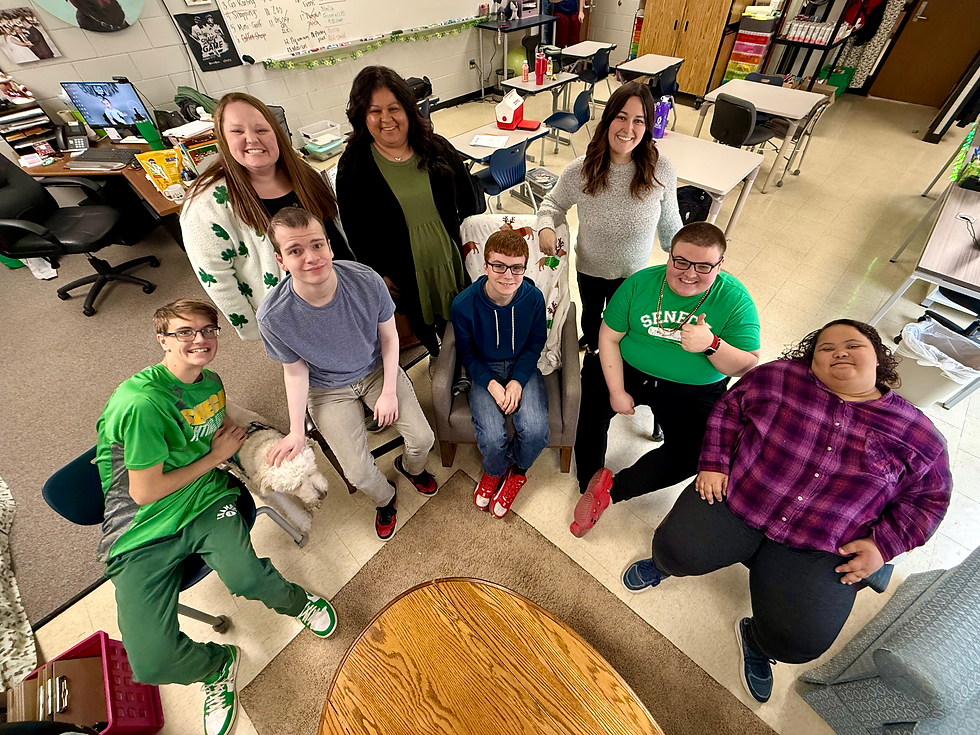
Allie Keinath's oldest brother is 43 years old and has Down syndrome. She's been doing this work her whole life — she just didn't always have the title. She taught self-contained math classes at Seneca High School for seven years. When the school separated its Transition program from its Life Skills program for the first time this year — giving students ages 18 to 22 their own dedicated space — she asked if she could lead it.
They said yes.
"This is the first year," she said. "It was always combined with the Life Skills program. Now they're getting a lot more job skills, a lot more opportunities to practice job skills, and get out of the building and have new bosses other than their teachers."
The room has a therapy dog named Lucky — two and a half years old, gotten as a "little fluff ball," now full-sized and loyal to no one in particular and everyone at once. Lucky has a basketball. The basketball belongs to Malachi.
Malachi Haines plays Special Olympics basketball. Last year, his team was snowed out of regionals and couldn't compete. This year, teams that had missed regionals were put in a hat. Malachi's team got drawn. They went to state and won. The SHS Varsity Basketball team was in attendance at the Shirk Center to watch Malachi drain 3’s. That’s the Seneca way; supporting one another. He walked into school wearing his medal. So Allie got Lucky a basketball, sat Malachi and Lucky together in a chair, and took a picture.
Malachi is also one of the class's outside-of-school workers. The program has several job sites — including 252, a restaurant above a marina on the Illinois River, named for its mile marker address. Malachi works there. His mom is his boss. He described the menu in detail: the specials rotate every other day, there's a burger, chicken nuggets, honey mustard, fries, and a lot of appetizers. The restaurant was closed for the winter when they talked — boats don't run on the river in January — but he said it reopens March 1st.
Once a week at 8:20 in the morning, the class goes to Refuge, a local coffee shop. Teachers place their coffee orders online. The students pick up the order and carry it back through the building to deliver it. Some teachers tip. I asked Malachi directly whether he thought the teachers tipped fairly. "To be honest, yes," Malachi said.
CiCi Honn — Cianna on paper, CiCi to everyone who knows her — loves music, colors, dancing. She doesn't actually like the taste of coffee. She prefers a pink drink: coconut milk, something sweet. She uses the tips she earns on deliveries to buy one. "The only way you get to buy smoothies is if you have enough money. And how do we get the money?" Allie prompted. "Tips," Malachi said.
CiCi graduates in May. She said she was upset about it — but there's a plan. After graduation, she'll ride public transportation, go to the YMCA twice a week through a social program, and work with DHS to find a job. She's been practicing for all of it here.
This fall, she was in the ensemble of Wicked Christmas, the school's fall production. She wore a beautiful green dress. It wasn't her first time on stage — she was in Cinderella before that. Stephan Wills remembered this before anyone else did, which is consistent with how Stephan operates. He has a remarkable memory. He also found an AI voice website through a YouTube ad once, and used it to make memes of his classmates' voices and of Lucky. He called it a one-off thing, but Allie said he very much loved it.
CiCi also won the classroom's "Progressiveness" award — one of the three P-words the class uses to describe the Seneca Way alongside Irish Pride and Irish Power. She got a Casey's gift card. Her photo went on the school TVs. At the time of this conversation, she was still on some of them. "I saw her this morning," Stephan said.
Cole Burchett came to the transition program from Life Skills — part-time this year, full-time next. He joined in January and has discovered a preference for pricing. The program runs two vending stations: one for students, where they make a small margin; one for teachers, where they sell at cost. Cole likes figuring out where the numbers need to be so nobody loses money. He also has a YouTube channel. More than 10,000 subscribers. Monetized. His plan after Seneca is to keep making videos. Mikey, who was sitting nearby and wants to be an entrepreneur, was immediately proposed as Cole's future agent.
Mikey draws. He builds family trees. He wants to start a business around genealogy and community giving. And he knows United States presidents cold — every one of them, including Calvin Coolidge's pet raccoon and the fact that James Buchanan was the only president never to marry. I should have seen it coming, but I ran out of questions to stump him. Mikey told me, "I knew we were still better than AI."
I asked each of them what made them happy. Malachi said basketball — and going to state. Cole said delivering papers through the building. CiCi said music, color, and dance. Stephan remembered that CiCi had been in Cinderella.
At the end of our conversation, I asked them to give themselves a round of applause. And they did.