
A community engagement initiative of Litchfield CUSD #12.
Winter | 2026
A Place for Everyone
"It gives them something that is theirs that they sort of take ownership of."
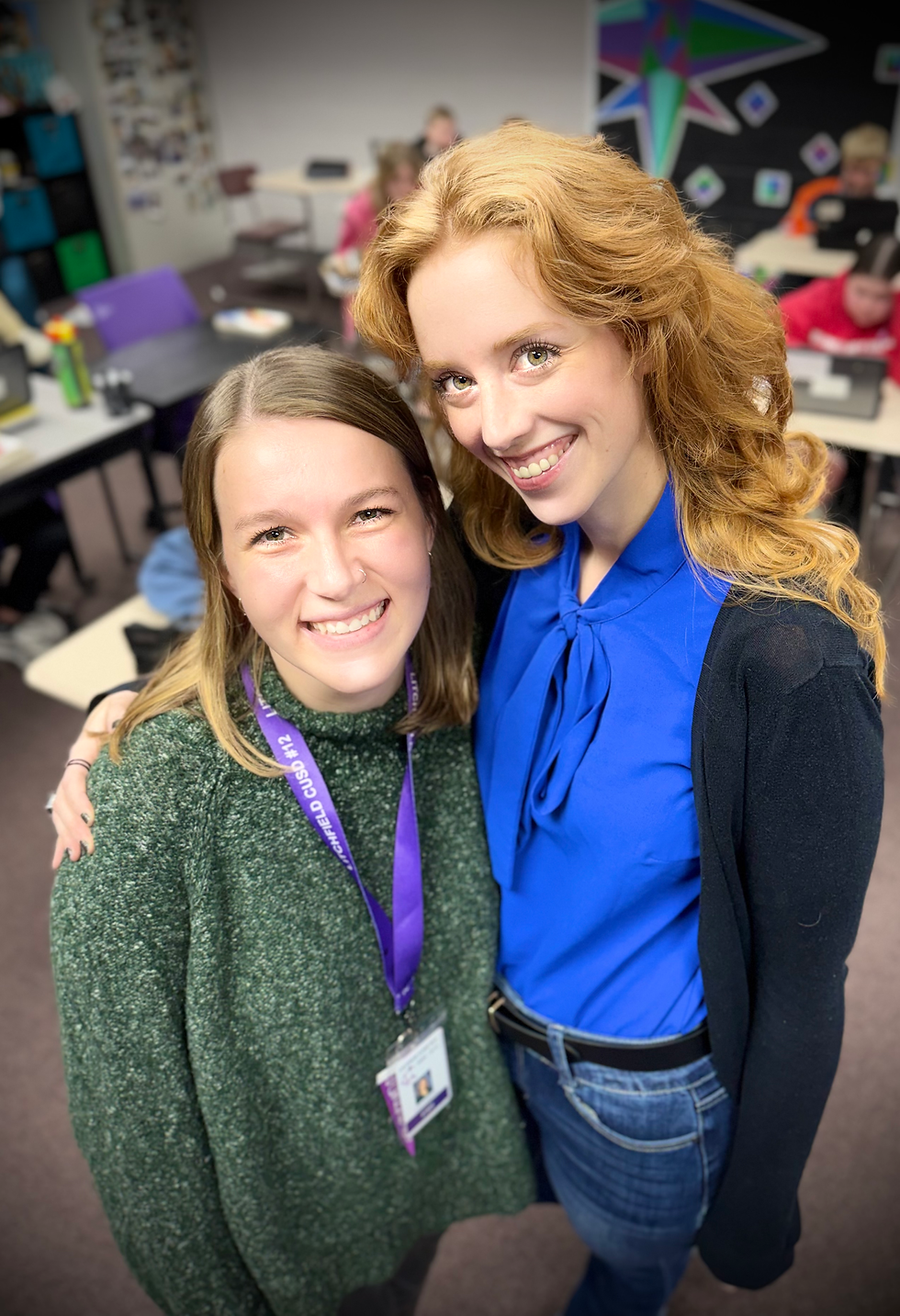
There are programs in every school that lift academics, sharpen skills, and prepare students for the future. And then there are programs that do something quieter, but just as vital: they give young people a place to belong. At Litchfield High School, that place is often found in the rooms run by English teacher Paige Sprankle and special education teacher Emily Frerichs-Caldieraro, two educators who share a best-friend bond, a deep well of empathy, and an uncanny ability to draw students in from every corner of the building.
Paige teaches English and drama and directs the school's annual musical alongside Emily—who co-teaches English classes as part of her special education role and somehow always ends up with her hand in the air when volunteers are needed. "I got sucked in again," Emily laughs. Their classrooms are a hub of energy, curiosity, and laughter—the kind of place where kids feel safe walking in as they are.
A decade ago, when Paige was still early in her teaching career, a student named Bree Hale walked up and asked if she could start a club—something she called the Pop Culture Club. She envisioned a space where students could geek out about the things they loved: video games, fandoms, superheroes, anime, musicals, movies. Paige said yes, of course, and later invited Emily along for the ride.
The first meetings drew maybe eight students. They brought Nintendo Switches, talked about the Avengers, and planned their first big outing—a trip to Wizard World Comic Con in St. Louis, where Paige's dad even met them to wander the show floor together. The kids loved it. A tradition was born.
Today, the club has exploded to 60–80 members each year—a staggering percentage of the student body for a rural high school. Students run for officer positions. They propose events. They plan lock-ins, Mario Kart tournaments, themed galas, and Comic Con trips. They create community, and they lead it.
"Sometimes it's just to have one other person," Paige says about why kids come. "Even if they're not being particularly social, they still—it's more of being with other people. They just play the video game next to each other... an adjacent friendship. And it's nice for the people who might not have a lot of friends or don't really have that bridge of actually making friends to where now they have something in common."
This club is a release valve for kids who carry more than they let on. It's a place where friendships form from adjacency—a shared interest, a shared table, a shared moment. It's a place where nobody judges you for being yourself.
Paige's reasons reach back to childhood. She grew up one of eight siblings—four biological, four adopted—and learned early how important it was to make sure every kid in a family feels loved. "I know it didn't take me very long when I got into high school to realize that not everybody had that same support," she said.
Emily's journey contains the same thread. She teetered between nursing and special education, but both paths centered around care and compassion. Now she's back teaching at her own high school, working alongside her former teachers—"now they're my colleagues and close friends," she says. The transition was awkward at first. "Finally, they were like, you can call me by my first name." But there's something special about it. "I can't imagine being anywhere else."
Together, alongside other members of the “Dream Team” (Cassie and Nick McKorkle, Ellis and Taylor Henley, Dede and Lloyd Irvin, and Larry Caldieraro), they've also built Litchfield's annual musical, which this year will be Chicago: Teen Edition, running March 19–22. Around 50 students will take the stage, and nearly as many will run lights, manage costumes, handle props, or support backstage operations.
The impact runs deep. Paige remembers a student's senior reflection during COVID. "The one thing that they were proud of, they'll miss, that they liked about high school was running the spotlight." She pauses. "That's not easy to do, and it's not an easy job, but it's something that we just sort of didn't think would be someone's big thing. And to that—that was my big thing. That was huge."
Emily sees the same thing in her special education work. "Whatever your child needs, these teachers will give them, as long as they ask for it, as long as they advocate for themselves," she tells parents in IEP meetings. "This is such a strong staff."
And that may be what both of them are really talking about: belonging—the quiet, transformational kind that gives kids their footing. "It gives them something that is theirs that they sort of take ownership of," Paige says. "And I like that about what we do. And that's why I like pop culture, and that's why I like working with the musical because it gives kids that thing."
Pop Culture Club is fun, yes. The musicals are impressive, yes. But beneath it all is something even bigger: two teachers using their gifts to help students discover their own.