
A community engagement initiative of Litchfield CUSD #12.
Winter | 2026
A Harmonious Duet
"It's something that you can do from very little until you die." [of music]
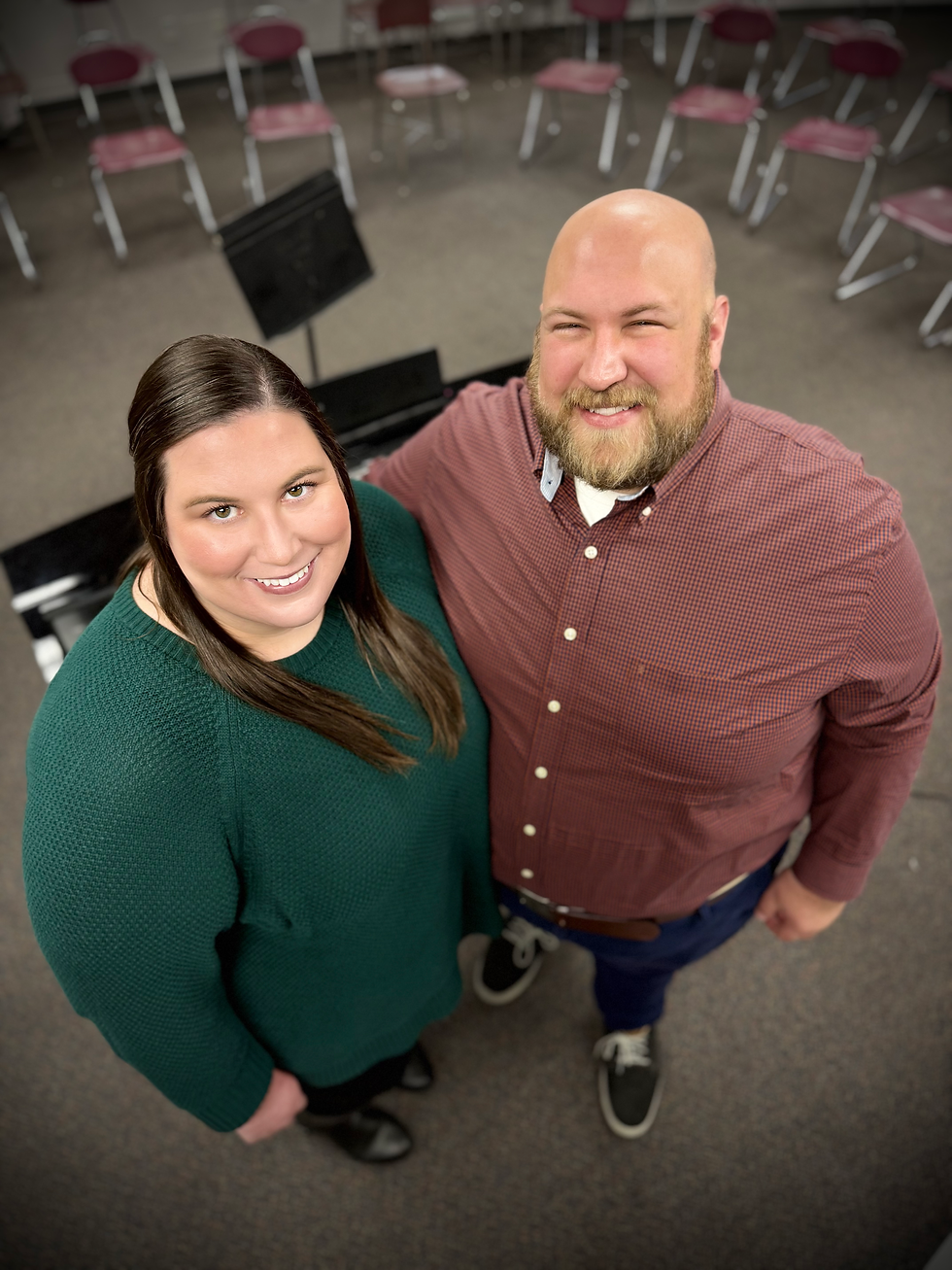
Taylor and Ellis Henley didn't plan on building a life around music side by side, but when two people grow up loving the same thing—and eventually discover they love it with equal conviction—their story begins to sound a lot like a duet. Today, they teach in two different Litchfield school buildings, but everything about their work feels woven together: their values, their energy, their belief in kids, and their understanding of what music can do that nothing else quite can.
They both grew up in Sparta, Illinois. Ellis came to the Randolph County town about 38 crow-fly miles northwest of Carbondale when his father accepted a position as the local Methodist minister. He’d walked unknowingly into the same church where Taylor already attended. They met through youth group, crossed paths again in school, dated through those final high-school years, and eventually both found themselves at SIU Carbondale studying music education. They graduated together in 2014, married in 2015, and have been building a shared career in the arts ever since.
Their early teaching lives were hectic in the way that only young educators juggling long commutes and K-12 music assignments can understand. In their first year, Taylor drove an hour north to Delavan while Ellis drove an hour south to Nokomis. "We never saw each other," they laugh, recalling that chaotic season. They lived in Springfield, taught in opposite directions, and were each responsible for everything—band, choir, all the events, every game, every musical. "We were it," Taylor says. "So we were very busy that first year."
But out of that exhausting year came clarity: Taylor, who originally wanted to be a band director, discovered she loved elementary music. Ellis recognized that his heart was in choral work, not band. Ellis was the first to land in Litchfield, taking the 6–12 choir position—where he also teaches seventh-grade guitar and high-school music theory. Taylor followed a few years later during the complicated post-COVID transition, earning the K–5 general music position.
Today, the two have carved out a rhythm that feels right. Taylor describes the energy of her youngest learners with unmistakable affection. "K–1–2… they love anything you put in front of them," she smiles. She focuses on creativity, improvisation, independence, and letting students take ownership—whether that's helping decide pieces for a program or running parts of a performance themselves. "Your parents aren't here to see me; they're here to see you," she tells her fifth graders. "I want them to be creative humans. And I want even the sportiest kid to find something in music they enjoy."
She also thinks about the long game. "I try to create educated consumers of music," she says. "When they become adults, when they are the people in this community who are saying, let's, you know, money for... I hope they remember, oh, I enjoyed music even though I didn't end up doing band. I see its value."
Ellis, meanwhile, sees music as one of the rare lifelong pursuits. At 35, he says his body no longer lets him play the sports he loved in high school—football, shot put, discus. "It's something that you can do from very little until you die," he says of music. "There are very few things in life that you can continue your entire life."
His program brings together students from every corner of the school—athletes, academics, quiet kids, and extroverts. "In a basketball team, there are five people that play and everybody else...it doesn't matter if you make a mistake because you're not in the game," he explains. "There are 45 of us, and we have to all be doing the exact same thing at the exact right time...We don't have the luxury of not including everybody."
Both Henleys talk with pride about the way Litchfield kids include one another—especially peers in life-skills classrooms who are integrated into music, art, and PE. "They become incredible helpers, incredible understanders, very compassionate empaths," Taylor says.
The two also play central roles in the district's growing performing-arts culture. Along with band director Cassie McKorkle and a tight-knit team of teachers, they help produce musicals in a space the district recently acquired—a former church building transformed into a true auditorium with theater staging and lighting. Taylor does costumes and plays euphonium in the pit band. Ellis sings or plays alongside her. "It's a dream team," Ellis says. "Everybody has their strength."
The space has even hosted community events, including a benefit concert for the hospital featuring Robbie Robinson—musical director for Frankie Valli and the Four Seasons, and a Litchfield native. Choir kids joined him on stage.
Ask them why music matters—why it matters here, where some may not always see the arts as essential—and their answers land with the force of lived truth. Music is culture. Music is community. Music builds creativity, empathy, confidence, and connection. Music gives every child a seat—no bench, no tryouts, no cuts.
In Litchfield, thanks to two teachers who found both their calling — and each other — early, that gift keeps growing.