
A community engagement initiative of Litchfield CUSD #12.
Summer | 2026
They Won't Forget Me
"I feel good about what I do because I do know that I've had clients tell me that I've made a huge difference — and that they won't forget me."
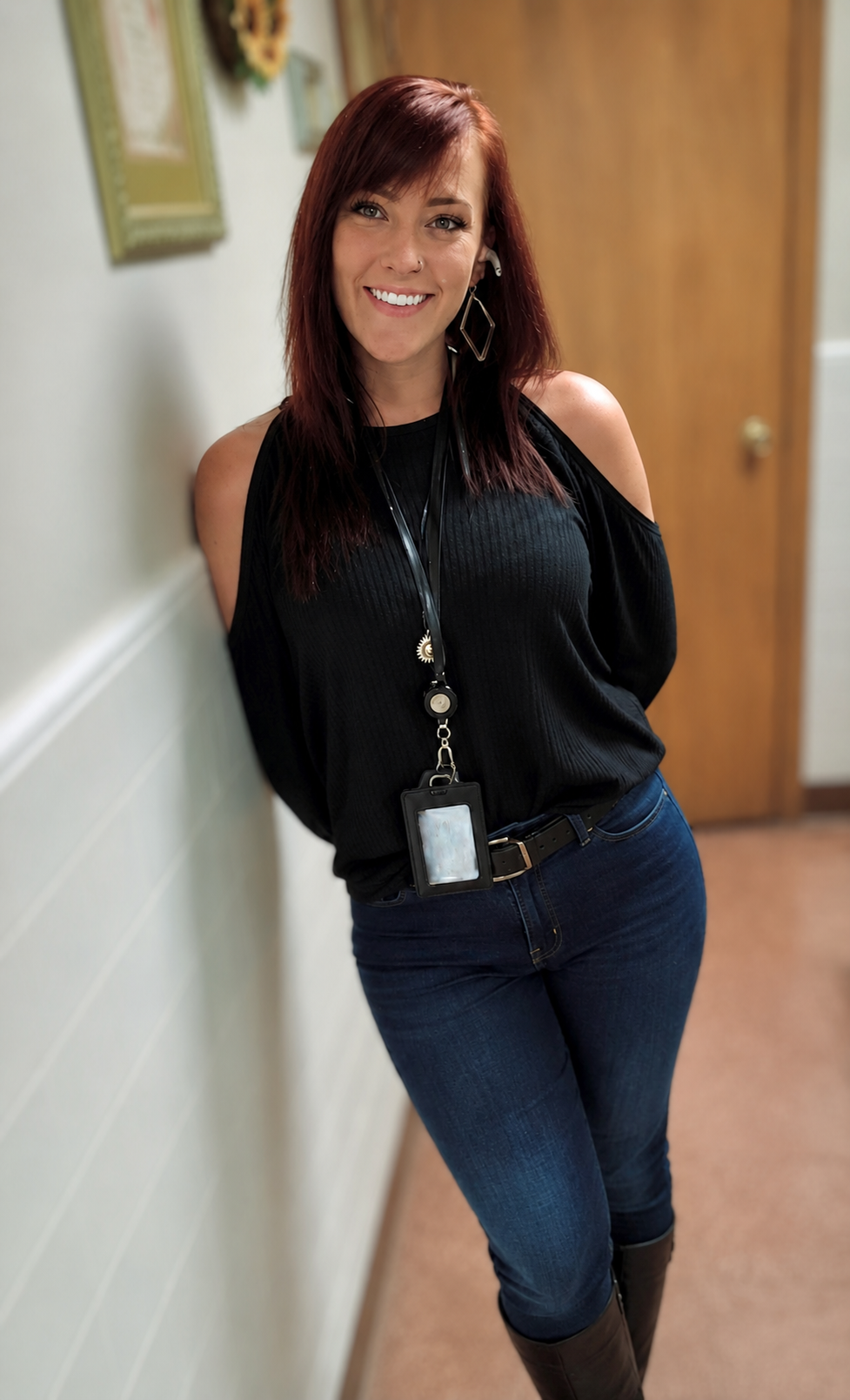
Kaghen Knox grew up in Waggoner, Illinois — a village small enough that Litchfield, twenty minutes away, felt like a city. Burger King was there. McDonald's was there. The bigger world was there. She moved to Litchfield at eight years old, started fourth grade, and grew up enough in that community to graduate with the Class of 2016.
She's back now — as a parent this time, with a son starting kindergarten in the fall. He's nonverbal and autistic, and she says the district has worked genuinely with her family through the new territory that brings. She has a lot to give to that community in return. She already is.
Kaghen works as a domestic violence advocate with SWAN out of their Vandalia office, serving Fayette and Clinton counties. The work has two main currents. The first involves helping victims navigate orders of protection, stalking no-contact orders, and court proceedings. She cannot speak for clients as an attorney would, but she sits beside them, walks them through the paperwork, and makes sure they aren't navigating the legal system alone. The second is a twelve-week virtual support group — part counseling, part education — covering the dynamics of abuse, its long-term effects on physical and mental health, and what it does to children caught in its path.
She came to the work through a circuitous route: an online criminal justice degree through Southern New Hampshire University, coursework that slowly surfaced different career paths, and then a job posting that appeared about six months before she graduated. "The moment I saw it, I knew I had to apply."
Behind that was something more personal. People she loved had experienced domestic violence. She'd wanted to help for years and not known how. The job was the how.
If she were advising a young person considering this kind of career, she'd start with one question: When you see two people arguing on the street, is there a specific tug in your chest? That pull toward intervention, that instinctive empathy — she believes it's what the work requires. Because the job asks you to bring your full self to someone else's crisis, regardless of what's happening in your own life. "You could be having the worst day of your life, and when someone calls and needs help, you kind of have to put your life aside."
She's candid about the limits. Some situations can't be fixed. Some people can't be reached in time. "Sometimes there are those times that keep you up a little bit when you're worried about someone, or you wish you could do more than you can." It lodges in you. And still she goes back.
One of the areas where her work has grown more complex recently involves technology. Digital abuse doesn't always look like what people expect. An abuser tracking a partner's location and noting the difference between a two-minute drive and a three-minute drive — that one minute becomes a trigger. Accessing email, monitoring social media, cycling through a shared password across every account. Advocates like Kaghen now receive specific training on technology and abuse precisely because these tools have made control so much easier to exercise invisibly.
Her son has also shaped her professionally in ways she didn't anticipate. Clients with nonverbal children face a safety planning challenge most people never consider: if something happens, the child can't run, can't call for help, can't describe what they witnessed. Having navigated those questions firsthand, Kaghen understands them in a way no classroom could teach.
"I think this world could use a lot more caseworkers," she says.
She's one of them. And her clients, she knows, remember her.