
A community engagement initiative of Byron CUSD 226.
Spring | 2026
Closer Than a Tenth of a Point
“Cheerleaders are just like every other athlete. They put in just as much work."
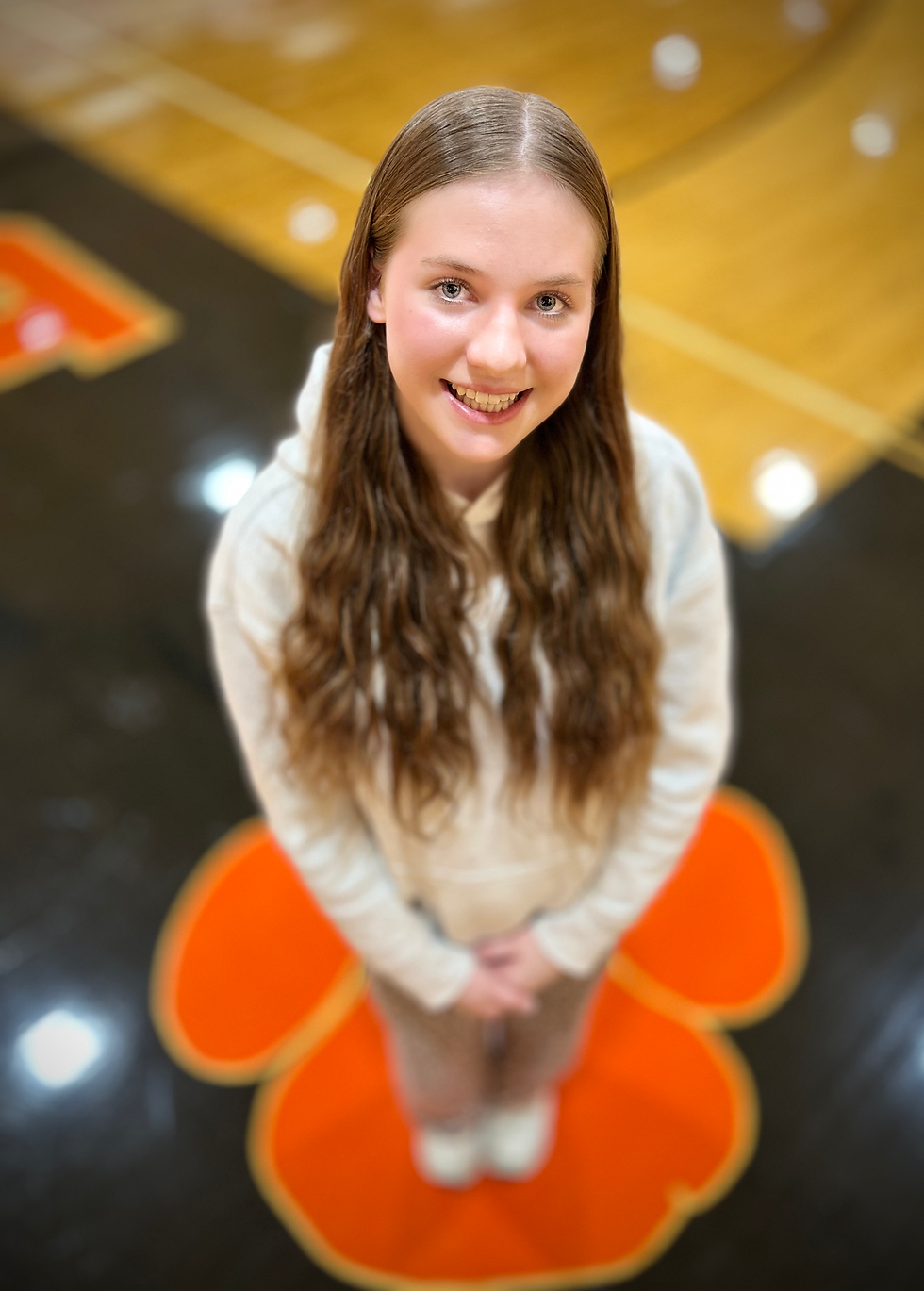
Kaleah Dale won the seventh-grade spelling bee. She mentions it almost as an aside, but it fits — she's someone who pays attention to the fine points of things. That precision has served her well in cheerleading, where the margins that determine a season can be measured in hundredths of a point. She knows that firsthand.
A senior at Byron High School, Kaleah has been cheering since seventh grade, when she tried out for the middle school team simply because she'd always loved watching gymnastics and thought cheer was the closest she'd get to it. She was right. By high school, she was competing, flying in stunts, tumbling, and working her way through every role on a competition squad. This year, as a base, she helped lead the Byron competition cheer team to a second-place finish at sectionals — punching their ticket to state for the first time in her career on the team.
Getting there took three years of near misses. In her sophomore year, their first together, the team placed seventh at sectionals. The top five advances to state. Junior year was harder to take — they finished sixth, missing the cutoff by 0.72 points. "Literally anything — even one point can change the whole game," she says. This year, they didn't squeak through fifth. They placed second. "We finally got there," she says.
The state competition was held at Grossinger Motors Arena in Normal, where 25 teams competed across two days. The top ten from day one advance to the finals. Byron placed 11th — missing the cut by 0.03 points. A deduction of 0.25 in their performance was part of it, but Kaleah is clear-eyed about the rest. "It could have been sharper tumbling, better stunt execution. Every little thing counts." She's proud. She's also haunted, just a little, by how close it was.
The competition season runs from December through early February, with contests nearly every weekend in January. Each season begins with a professional choreographer brought in for two straight eight-hour days to build the routine from scratch, working with what the team can actually do — who can fly, what tumbling passes are in the arsenal, and which stunts are achievable. From there, coaches Rebecca Bawinkel and Kassie Rosecke take the team through months of practice, constantly refining. "If you look at our routine from our first competition compared to our last one, it is not the same," Kaleah says. "You're always changing things to make it better."
This year's team had ten athletes — two stunt groups, each with a flyer, two bases, and a back spotter, plus two additional members maintaining motion and transitions throughout the routine. Kaleah was a base. She flew from seventh grade through her sophomore year, when she was one of the team's primary flyers. As athletes joined the program and the team needed bases, she made the switch. She adapted without complaint. That's part of what you do.
What she wants people to understand about competition cheer is the athletic demand behind what looks, from the outside, like performance. A routine runs two to three minutes. There are no breaks in those minutes — tumbling, stunting, jumping, yelling from the diaphragm, throwing people into the air, and landing skills that took years to build. "You never really catch a break during the routine," she says. At a school she describes as very football-focused, she's aware that cheerleading doesn't always get the same recognition as other sports. She'd like that to change. "Just remember how much dedication we have to it, how much time and effort we put in. Cheerleaders are just like every other athlete. They put in just as much work."
After graduation, Kaleah heads to Marquette University in Milwaukee, where she's been accepted into a three-plus-three accelerated doctoral program in physical therapy — completing what would typically be seven years of schooling in six. She's a National Honor Society member. She hopes to cheer in college if the opportunity is there, and if it isn't, she plans to keep tumbling anyway. She's been working on her tumbling since freshman year. She has it now. She's not done yet.