
A community engagement initiative of Jasper County CUSD 1.
Summer | 2026
Five Minutes Full
"Growing up in rural Jasper County, learning the value of hard work would be a big takeaway."
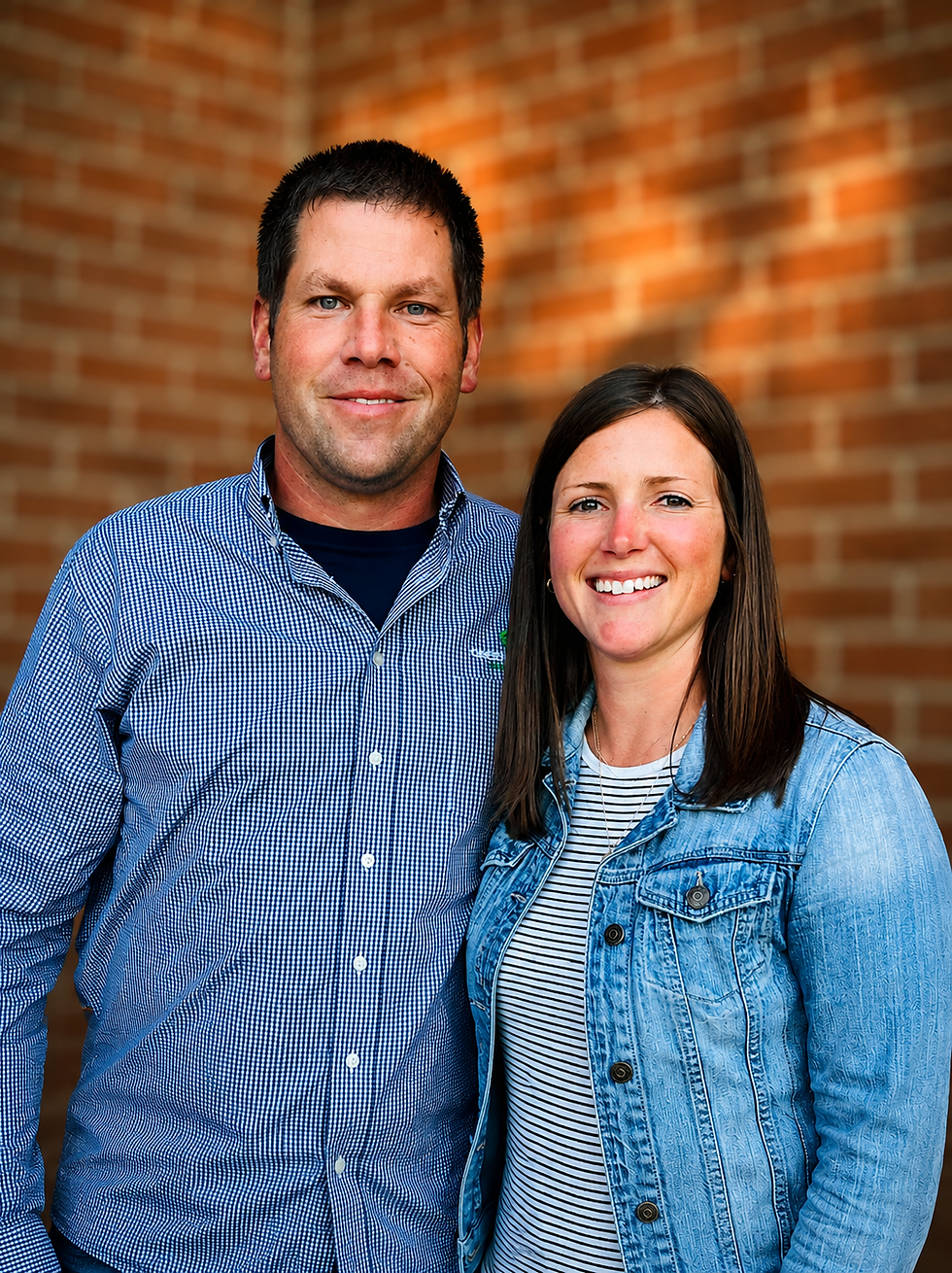
The agricultural drones Tony Weber flies carry up to 26 gallons of liquid product — roughly 200 pounds of payload — through the air at 10-15 feet above a field. Empty, the drone stays aloft for about twenty minutes. Fully loaded, it's in the air for five.
Most of the time, a crew empties the tank and brings the drone back in seven or eight minutes.
Tony is a 2008 graduate of Newton Community High School, and he'll be the first to tell you that when he left Syngenta in 2019 to spend more time on his family's farm, none of this was the plan. Drone spraying seemed like it might be a nice supplemental income that wouldn't interfere with planting and harvest seasons. He spent a couple of years doing small-scale experimental treatments — essentially proving crop protection products on-farm, the same products he'd spent seven years selling for Syngenta. The work was modest. He kept going.
In 2022, Tony and his wife Allison — also a Newton Class of 2008 graduate — took that experimental business and partnered with The Equity, a south-central Illinois agricultural cooperative that supplies inputs to farmers across the region, to form Green Creek Drones. The structure was deliberate: a 50/50 partnership, run as a separate entity, with the sole focus of drones. The Equity felt the drone business was complex enough that it would get lost inside their everyday operations. Being distinct from everything else they did, Tony believes, is part of why it worked. And because all Green Creek Drones employees are technically Equity employees leased to the company, every full time team member has access to health insurance, 401k, and full benefits — a recruiting advantage most small startups can't offer.
This summer, 24 people will be operating drones for Green Creek, spread across 12 aircraft. Each crew has a pilot and an assistant. The assistant manages batteries, refills the tank, handles questions from curious bystanders, and keeps an eye on what's coming next — so the pilot can stay focused. Best-case scenario, the operation can spray 80 acres in an hour. When fields are small or oddly shaped, that number comes down considerably.
Getting someone ready to operate is more involved than most people expect. There's the FAA Part 107 Remote Pilot Certificate, which Tony helps pilots earn through online training. The test doesn't reward memorization. "You have to learn it and understand it and apply it," he said. "You don't get to just memorize things and spit them back out." Then there's a state-specific pesticide applicator license, because what the drone applies requires legal authorization to handle. Then two business-level certifications that cover the pilots operating underneath them. Real-world proficiency — managing battery life, payload, landing zones, and changing field conditions — takes another ten days to two weeks. And the aircraft themselves, which have four arms and eight motors in stacked pairs for redundancy, are not forgiving if the training is skimped. Tony's crews have flown back on seven motors after one failed. They've prevented the crash. Barely.
The business is growing, though Tony describes it with characteristic care: "Maybe we're not an infant, but I think we're a toddler. Got a little stability. We've proven there's a viable model here." He's not chasing national scale. He's chasing sustainable, manageable growth — in an industry he believes is still in its early innings.
Agriculture has been an early adopter of technology for generations. GPS, yield mapping, precision planting, data analytics — the straw hat and pitchfork image of farming has been wrong for decades. "Oftentimes, the image is a pitchfork and a straw hat, and it couldn't be further from the truth in many cases."
The thread connecting all of it, for Tony, runs back to a school bus. Diane Ruholl for over 4 decades, loaded a group of Jasper County teenagers onto one and took them to detassel corn — walking hot fields in July at 13, 14, 15 years old. The work taught something that all the advanced software and federal certifications in his current world still require: show up, do the work, don't quit.
The four kids he and Allison are raising, ages three to nine, attend school in Jasper County. He's not going anywhere.
"This is not a one-man show, we have fantastic teammates that deserve a ton of credit" he said at the end of the conversation. "I'm a believer, and I believe that God has blessed us. It would sure be a shame if I didn't call those things out."